top of page

All Posts

Automatically convert phone calls and site-walk conversations into Fieldwire tasks, daily reports, punch items, and schedule updates, eliminating manual data entry, reducing rework, and giving teams real-time visibility across the jobsite.


Hardline and Fieldwire integration streamlines jobsite communication and task management


Construction projects demand clear communication and fast, accurate documentation. Yet, many teams still spend hours typing notes, updating tasks, and chasing down details after conversations on the jobsite. This slows progress and increases the chance of mistakes or missed information.


Now, a new integration between Hardline and Fieldwire changes the way teams capture and act on jobsite conversations. By turning spoken words into real-time updates and tasks, this voice-first AI platform helps crews stay aligned and saves valuable time.


How the Integration Works


Hardline uses voice recognition and AI to listen to conversations on the jobsite. When a worker talks about a task, update, or issue, Hardline captures the details and sends them directly into Fieldwire. This means:


  • No typing required: Workers speak naturally, and the system updates Fieldwire automatically.

  • Real-time task creation: Calls and on-site talks turn into actionable tasks instantly.

  • Context flows seamlessly: Updates include all relevant details, reducing confusion.


For example, if a foreman says, “Check the wiring in the east wing and replace any damaged cables,” Hardline records this and creates a task in Fieldwire with the exact instructions. The team can then track progress without delay.


Benefits for Field Teams


This integration offers clear advantages for crews working in the field:

  • Fewer missed details: Voice capture reduces errors caused by forgotten or miswritten notes.

  • Less rework: Accurate, timely updates help avoid mistakes that lead to costly corrections.

  • Time saved on documentation: Teams spend hours less each week on paperwork and data entry.

  • Improved alignment: Everyone stays on the same page with up-to-date information flowing directly into Fieldwire.


By cutting down on manual updates, workers can focus more on their core tasks and less on administrative work.


Practical Use Cases


Here are some ways teams can use the Hardline and Fieldwire integration to improve their workflow:


  • Daily stand-ups: Instead of writing notes, supervisors speak updates that automatically populate Fieldwire’s task lists.

  • Issue reporting: Workers report problems verbally, creating immediate tasks for resolution.

  • Change orders: On-the-fly changes discussed on-site get documented and assigned without delay.

  • Safety checks: Voice-recorded safety observations turn into follow-up actions tracked in Fieldwire.


These examples show how natural conversations become structured work items, speeding up communication and follow-through.


Getting Started with the Integration


To begin using Hardline with Fieldwire:


  1. Connect your accounts: Link Hardline and Fieldwire through the integration setup page.

  2. Train your team: Introduce voice commands and best practices for speaking clear, actionable updates.

  3. Test on-site: Start capturing conversations during meetings or walkthroughs and watch tasks appear in Fieldwire.

  4. Refine workflows: Adjust how you use voice updates to fit your team’s specific needs.


The integration is designed to be easy to adopt and built specifically for field conditions.


Why This Matters for Construction Productivity


Construction projects often face delays due to poor communication and slow documentation. By turning spoken words into immediate action, this integration helps teams:


  • Keep projects moving without waiting for paperwork.

  • Reduce errors caused by lost or misunderstood information.

  • Save hours each week that can be redirected to actual construction work.


This practical tool supports crews in staying organized and efficient, which benefits the entire project timeline and budget.


The Hardline and Fieldwire integration transforms how jobsite conversations become work. By capturing voice updates and sending them directly into task management, it removes barriers between communication and action. Teams can spend less time typing and more time building.


Explore the integration today and see how your crew can save time, reduce mistakes, and stay aligned with every conversation on site. Your words can now lead to real action faster than ever before.


Schedule time to get onboarded to Hardline and connect your Fieldwire in within minutes.


Walk any jobsite today and you’ll see the same tension: construction teams know they need better technology, but the software bills keep climbing. Procore, Autodesk, estimating tools, scheduling tools, timekeeping apps, safety apps… pretty soon a GC is staring at a five–to–six figure annual software budget and wondering:


“Are we spending too much?”


It’s a fair question. Here’s what contractors actually spend—and the point where software becomes either a competitive advantage or a money pit.


1. What contractors actually spend on software today


Most contractors spend 0.3% –0.7% of revenue on software. That translates to roughly:

  • $700–$2,000 per employee per year

  • Higher spend for commercial GCs, lower but rapidly rising for residential builders

  • A full tech stack including: PM platforms, accounting/ERP, estimating, HR/payroll, field tools, communication tools, and safety tools


This means:


  • A $10M builder spends around $30k–$70k/year

  • A $50M commercial GC likely spends $150k–$300k/year

  • A $100M GC can spend $300k–$600k/year


And yes—software costs have crept up over the past decade. But the more important question isn’t how much GCs spend. It’s what they get back.


2. Does spending more on software actually pay off?


Short answer: yes—but only when it’s the right software and it’s adopted well.


  • Deloitte’s economic modeling (across 600+ contractors) found that adding one new digital tool correlates with +1.1–1.4% annual revenue growth.


  • For a $100M GC, that’s $1.1–1.4M in incremental top line—per new tool.


High-skill users of project management software see real margin gains. A 2025 Dodge + Procore study found:


  • 77% of high-adoption firms increased profit margins

  • 83% reduced overhead by 5% or more

  • 70%+ said they could handle more volume with the same staff


This is exactly what software is supposed to do, increase capacity without increasing headcount. But this leads business owners to ask the question, "what are my most expensive and urgent needs today?". Software can absolutely make contractors more money. But not all software spend is created equal.


3. So how much is too much?


You’re spending too much on software when your field teams aren’t using it.


Not when the bill is high, Not when you have “too many tools.” Not when you’re paying for integrations....Only when the software’s adoption is low and the workflows don’t change.


To be more specific, we made a quick checklist. You are overspending if:


  • You have more licenses than active users

  • The field sees software as “more admin work”

  • Tools don’t talk to each other

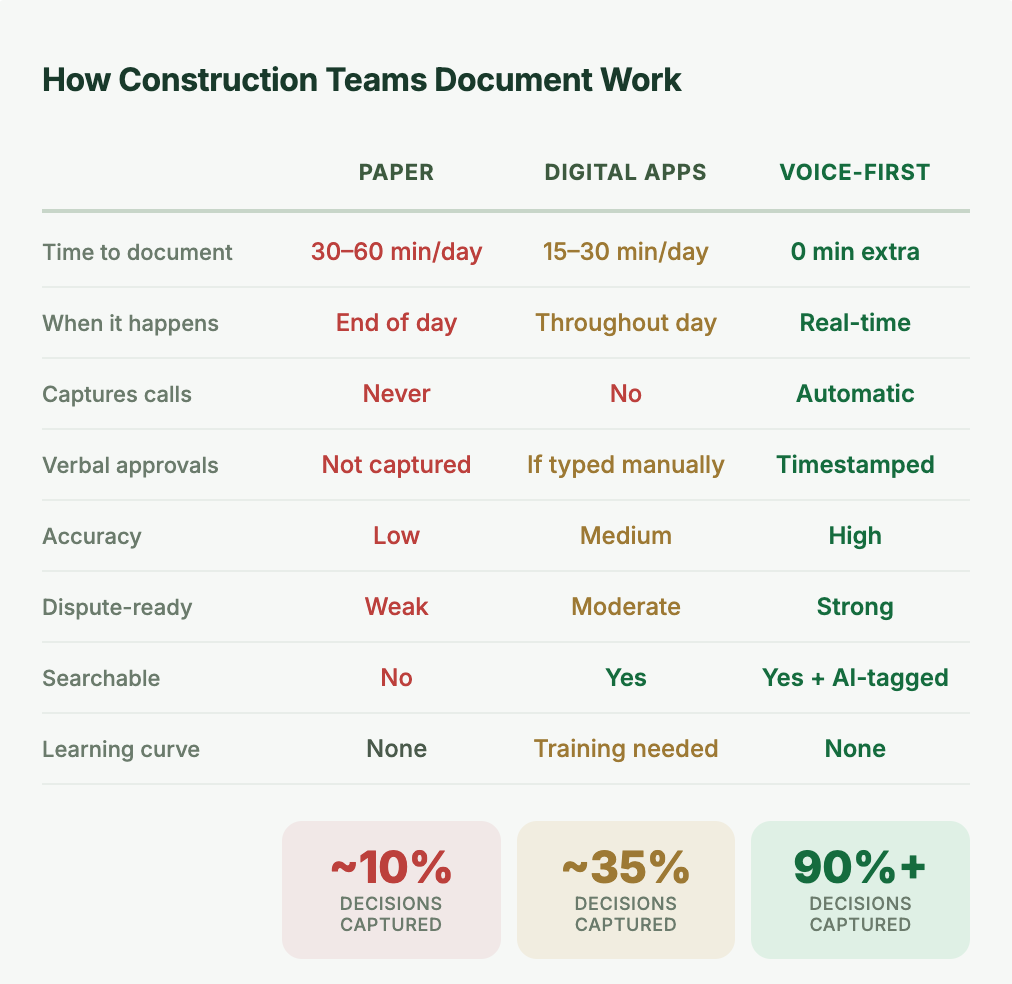
  • Work still happens through text messages, phone calls, or paper

  • PMs are double-entering the same info into multiple systems

  • Leadership can’t measure the ROI of any tool in the stack


This is the classic trap: a GC buys sophisticated tools, but teams continue to operate in the old way.


On the other hand, you are spending the right amount if:


  • Software replaces manual tasks—not adds to them

  • Field teams use it without needing training or new habits

  • The tool captures data teams were already generating

  • It makes your team faster, reduces rework, or cuts overhead

  • It increases project capacity without adding headcount

  • You can clearly connect the spend to margin or risk reduction


4. The one category where almost every GC underspends

Across all the research, one pattern kept showing up: Contractors massively underinvest in communication and documentation tools—despite miscommunication being a top driver of rework and claims.


Everyone invests in PM platforms.

Everyone buys estimating tools.

Everyone pays for scheduling and accounting.


But the biggest source of risk in the industry—

verbal decisions that never get documented—

has been left wide open.


Hardline exists because decades of jobsite insight show:


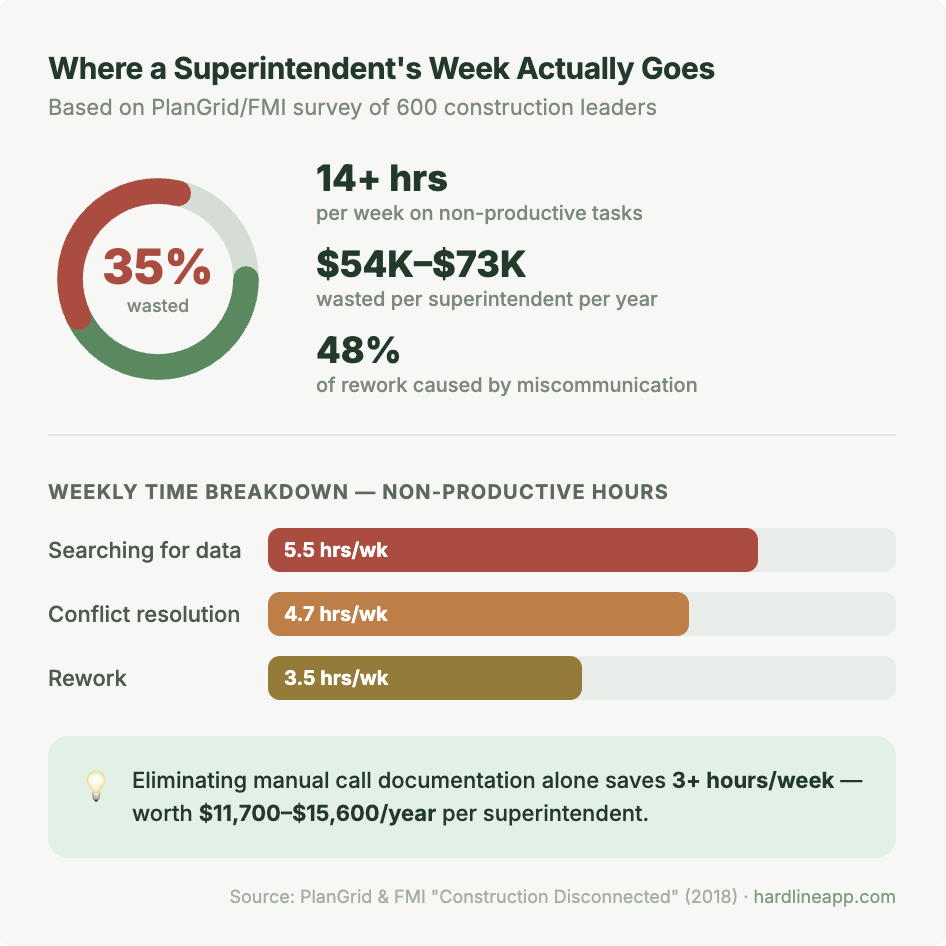
  • Supers make 30–50+ calls a day

  • Fewer than 10% get documented

  • Those undocumented calls drive rework, disputes, delays, and cost overruns


Software spend isn’t about “more tools.” It’s about covering the gaps where bad information costs real money.


5. A simple framework for GCs: “Software ROI in 10 minutes”


If you want to know whether your firm is spending too much, ask:


  1. Does this tool remove admin or create admin?

    1. If it adds admin → cut or replace.


  1. Does it reduce rework, delays, or callbacks?

    1. If not → it’s not mission-critical.


  1. Does it enable more volume without adding staff?

    1. If yes → keep it and double down.


  1. Is the field using it daily without being forced?

    1. If not → adoption problem → rethink.


  1. Can leadership point to hard ROI within 6 months?

    1. If no → reevaluate or renegotiate.


You don’t need 40 tools, you need the right 6–10 tools used effectively and consistently.


Most GCs aren’t spending “too much” on software, they’re spending on the wrong things or getting too little in return. The research is clear:


  • Smart digital adoption increases revenue

  • High-use teams see higher margins

  • Better data = fewer costly mistakes

  • Communication tools are the biggest blind spot in the industry


And the best-performing contractors all share one trait:


They treat software as a profit center, not an expense.


The week of Suffolk BOOST DEMO Day in Boston brought together builders, tech developers, and innovators eager to explore how technology can reshape construction. This event showcased practical advances in construction AI and Voice AI, highlighting tools that improve safety, efficiency, and communication on job sites. The energy throughout the week was contagious, with demos, insightful talks, and networking that sparked new ideas and partnerships.


Alena Tuttle, CEO of Hardline, Presenting at Suffolk BOOST's Demo Day

A Week Focused on Construction Tech Progress


Boston Built Week was a week-long series of activities designed to dive deep into construction tech. Each day featured different themes, from AI-driven project management to Voice AI applications that simplify communication on noisy sites.


Attendees saw firsthand how construction AI tools and robotics can enhance worker's lifestyles - not replace them. Cyphra Autonomy makes construction operations safer, more efficient and faster with our material moving robots...they demo'd live.


Voice AI also took center stage. Builders tested voice-activated assistants that allow hands-free reporting and task updates. This technology reduces the need for manual data entry and helps teams stay connected without stopping work. For example, a foreman could update project status or request materials simply by speaking, even while wearing gloves or handling tools.


Real Stories from the Floor


One of the most memorable moments came from Dig Energy, a startup that developed a new drill that unlocks the massive potential of distributed geothermal energy by radically reducing the cost of drilling. They brought the drill on stage... crazy.


Another highlight was a panel discussion featuring contractors who have integrated construction AI into their workflows. They shared stories about how predictive analytics helped them avoid costly delays caused by weather or supply chain issues. These real-world examples made the technology feel accessible and relevant.


Building Connections and Future Collaborations


Networking was a key part of the week. The event created space for startups, investors, and construction professionals to meet and explore partnerships. Many attendees expressed excitement about combining Voice AI with other construction tech to create smarter, more responsive job sites.


Bricks & Bytes recently hosted an engaging live podcast featuring all BOOST participants, creating a dynamic platform for sharing insights and innovations in the construction industry. The event highlighted the collaborative spirit of the BOOST initiative.


Karly Heffernan & Alena Tuttle on Bricks & Bytes Podcast


What This Means for the Construction Industry


Built Week Boston and Suffolk's BOOST Demo Day demonstrated that construction tech is moving from experimental to essential. Tools powered by construction AI and Voice AI are no longer futuristic concepts but practical solutions that improve how projects run. They help reduce risks, save time, and keep teams better connected.


For those in construction, this means investing time to understand and adopt these technologies can lead to stronger project outcomes. The event showed that even small changes, like using voice commands for updates, can make a big difference on site.


The week also highlighted the importance of collaboration between tech developers and construction professionals. Building solutions that truly fit the industry's needs requires ongoing dialogue and testing in real environments.


Moving Forward with Innovation


The Suffolk BOOST DEMO Day in Boston was a clear sign that construction is ready for change. The showcased technologies offer tools that support workers and managers alike, making projects safer and more efficient. As construction AI and Voice AI continue to evolve, their impact will grow.


If you're interested in getting early access to Hardline; an app that allows construction workers to run the jobsite with just their voice, book a demo with us!


bottom of page