Construction Documentation in 2026: Why Voice-First Tools Are Replacing Clipboards and Typing
The best way to document construction jobsite activities in 2026 is voice-first documentation, using the phone calls and conversations that already happen on the job to automatically generate structured records. Unlike manual methods that require typing or form-filling, voice-first tools like Hardline capture decisions, tasks, and updates from natural phone calls, saving superintendents up to 2 hours per day.
The best way to document construction jobsite activities in 2026 is voice-first documentation, using the phone calls and conversations that already happen on the job to automatically generate structured records. Unlike manual methods that require typing or form-filling, voice-first tools like Hardline capture decisions, tasks, and updates from natural phone calls, saving superintendents up to 2 hours per day.
There's a running joke in construction that the best-documented project is the one where nobody got sued. Which... is technically true. But it shouldn't take a lawsuit to make documentation a priority.
The reality is most jobsite documentation still happens the same way it did 20 years ago. Somebody writes it down at the end of the day, if they remember. They fill out a form, type up a daily log, maybe attach a photo if they're feeling ambitious. And the most critical stuff, the phone calls, the verbal approvals, the "yeah go ahead and pour it" conversations, never gets documented at all.
That's the gap. And it's costing the industry billions.
The Current State of Construction Documentation
Let's be honest about where things stand.
According to Autodesk's construction industry data, construction professionals spend roughly 35% of their time on non-productive activities, hunting for project information, resolving conflicts, and dealing with rework. That's over 14 hours per week per person spent not building.
A Levelset survey found that nearly 75% of construction professionals spend less than half their time doing actual construction work. And 85% report spending more than a quarter of their hours just tracking and reporting on project progress.
Meanwhile, 20% of construction companies don't use any construction software at all. One in five. In 2026. Still running on paper, spreadsheets, and memory.
And the companies that have gone digital? Many of them just digitized the same broken process. Paper forms became PDF forms. Clipboards became tablets. The data entry is faster, but someone still has to stop what they're doing and type.
The Problem with "Digital" Documentation
Don't get me wrong, going from paper to digital is an upgrade. Procore reports that digital tools can create punch items three times faster than manual methods. Automated workflows cut admin time by 30-40%. That's real.
But here's what nobody talks about: digital documentation still assumes someone has time to sit down and type.
Your superintendent is managing 50+ calls a day. They're walking the site, coordinating subs, handling deliveries, putting out fires. When exactly are they supposed to pull out a tablet and fill in a daily log template?
The answer is usually: at the end of the day. Which means they're documenting from memory. Hours after the conversations happened. And if you've ever tried to accurately recall a 7am phone call at 8pm after twelve hours on a jobsite... you know how that goes.
According to Texas A&M research, misinterpretation and manual data entry errors are among the top contributors to rework. Not because people are careless. Because they're exhausted and documenting things after the fact.
What Gets Lost (and What It Costs)
Here's what falls through the cracks every single day on construction sites:
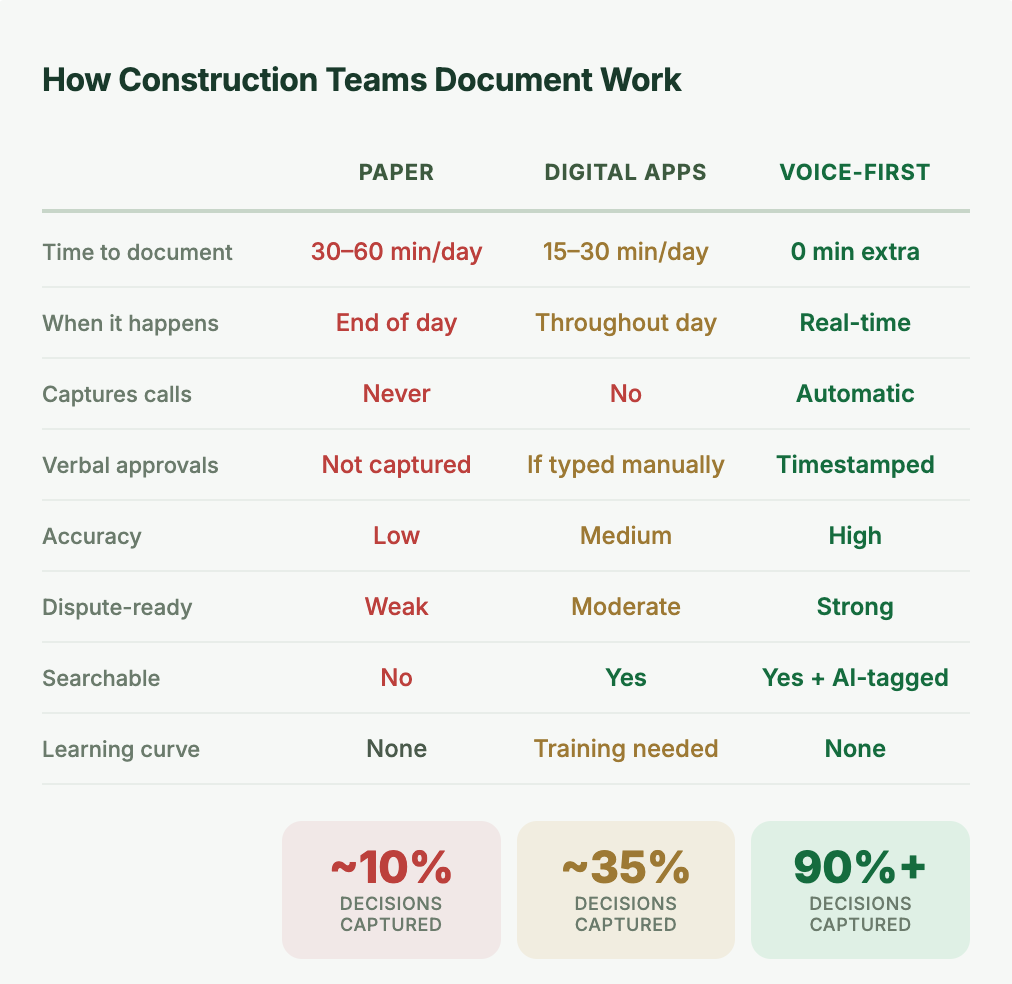
Phone calls. The average super handles 50+ calls per week. Schedule changes, material substitutions, verbal approvals, scope discussions, all happening over the phone. Less than 10% gets formally documented. That's 45+ calls per week with zero paper trail.
Verbal change orders. Someone says "go ahead" on a call. Six weeks later it's "we never approved that." No documentation, no defense. (We wrote a whole post on how to prevent construction disputes before they start, spoiler: it comes down to this.)
Daily context. Who was on site, what got delivered, what decisions were made, who said what to whom. The stuff that matters in a dispute and disappears within 24 hours if nobody writes it down.
The cost? The PlanGrid/FMI research puts it at $177 billion per year in wasted productivity across the U.S. construction industry. And nearly 18% of project time is currently lost just searching for data that should've been captured the first time.
Poor daily logging practices are a hidden risk, missed details can cost millions in claims. And in 2026, courts and insurance adjusters are prioritizing timestamped, task-linked data over manual spreadsheets. If your documentation doesn't have a timestamp and a source, it's not evidence. It's a story.
Voice-First Documentation: The Shift That's Actually Happening
Voice-first documentation isn't a concept. It's already here.
Instead of typing up what happened, you capture it as it happens, through the conversations you're already having. Phone calls get transcribed in real time. Decisions get tagged. Tasks get extracted. Everything syncs to your project management tool automatically.
Construction Business Owner reports that voice-to-text applications can reduce daily reporting time by up to 12%, and because the documentation happens in real time, it eliminates the end-of-day scramble entirely.
But the real value isn't the time savings on reporting. It's capturing the stuff that was never being documented in the first place.
Think about it. Your most important project decisions happen on phone calls. Voice-first tools turn those calls into searchable, timestamped records with tasks and action items pulled out automatically. That's not replacing your daily log, it's capturing the 90% of information that never made it into the daily log.
What This Looks Like in Practice
At Hardline, we built voice-first documentation specifically for construction phone calls.
You make your normal calls, to subs, GCs, owners, suppliers, whoever. Hardline transcribes the call in real time, uses AI to extract the tasks, decisions, and commitments, and syncs everything to Procore, Fieldwire, or Autodesk Forma.
No typing. No forms. No "I'll log it later." Your 7am call with the electrician becomes a documented summary with task assignments by 7:02am.
For the superintendent who's juggling 50+ calls a day, that's the difference between a project with a complete paper trail and a project where 90% of decisions live in somebody's head.
The Documentation Hierarchy in 2026
Not all documentation is created equal. Here's how it stacks up:
Best: Automatic, real-time capture. Voice documentation, AI-extracted tasks, timestamped records. Happens in the moment, no extra effort required.
Good: Digital tools with mobile entry. Daily report apps, photo documentation, digital punch lists. Better than paper, but still requires someone to stop and type.
Baseline: End-of-day manual logs. Better than nothing. But you're documenting from memory, hours after the fact. Details get lost.
Worst: No documentation. Still happening on 20% of jobsites. Every undocumented conversation is a potential dispute waiting to happen.
The industry is moving from the bottom of this list toward the top. The question isn't whether voice-first documentation will become standard, it's how much money you lose before you adopt it.
The Bottom Line
Construction documentation in 2026 isn't about better templates or fancier apps. It's about capturing information that was never being captured before, the phone calls, the verbal agreements, the on-the-fly decisions that actually run your projects.
The teams that figure this out save hours per day on admin, build better paper trails for disputes, and spend more time doing what they're actually paid to do: build.
The ones that don't keep losing $177 billion a year to information that disappeared.
Hardline turns every construction phone call into documented, organized project data, automatically. No typing, no forms, no learning curve. Book a 20-minute demo and see how it works.
Sources
- Autodesk: 100+ Construction Industry Statistics, 35% of time on non-productive activities, PlanGrid/FMI $177B waste data - Levelset: 2020 Construction Survey, 75% spend less than half their time on actual construction; 20% use no software - Procore: Construction Daily Reports, Digital tools create punch items 3x faster - Construction Business Owner: Voice-to-Text Mobile Reporting, 12% reduction in daily reporting time with voice tools - Fieldwire: Construction Daily Report Best Practices, Poor logging as hidden risk - Lightyx: Complete Guide to Construction Technology 2026, 18% of project time lost searching for data - Procore: 2026 Construction Tech Trends, Industry shift toward ambient capture - Fulcrum: Manual vs. Digital Field Inspections, Comparison of documentation methods
Alena Tuttle
Ready to capture every conversation?
Hardline turns your calls and site conversations into daily logs, RFIs, tasks, and more, automatically.
Get started