Field-First Technology Adoption in Construction
Buying software is easy. Getting the superintendent to use it on day 30 is the hard part.
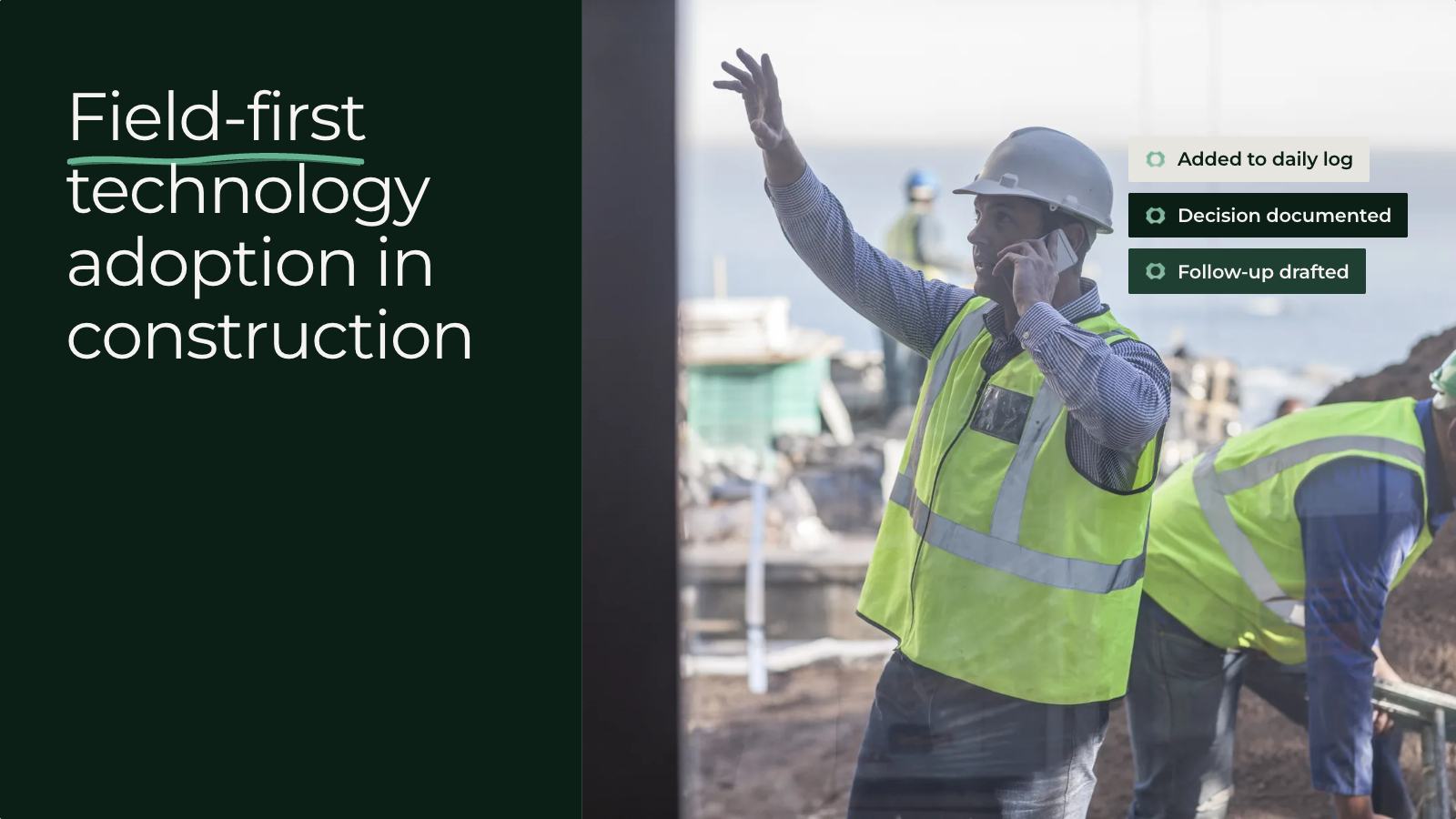
Construction teams have more technology available to them than ever: project management platforms, daily reporting apps, reality capture, drones, scheduling tools, AI copilots, AI note takers, safety software, workforce management, and document control. The list gets longer every month.
And yet the biggest question in construction technology adoption has barely changed: will anyone in the field actually use it?
That question matters more than almost any feature on a software demo. A contractor can buy the most powerful tool in the world, roll it out across 50 projects, create accounts for 500 employees, and still capture very little value if the people closest to the work don't use it consistently.
That's the difference between deploying technology and adopting technology.
Construction is buying technology. Adoption is still the hard part.
The industry is not ignoring technology. In the 2025 AGC and Sage Construction Hiring and Business Outlook, 69% of contractors said they use mobile software for daily field reports, with many also using it to pull up job information and manage punch lists from the field.
The same survey exposes the harder part. Among contractors' biggest IT challenges:
- 38% cited the time required to implement and train employees on new technology.
- 36% cited employee resistance to technology.
- 32% cited communication between the field and office.
- 28% cited integration between software used within the company.
AI hasn't made the problem go away. Bluebeam's AEC Technology Outlook 2026, a survey of more than 1,000 AEC professionals, found that 89% of firms are not yet fully digital across every project phase, and nearly half still rely on paper for critical workflows.
Trimble surveyed 1,800 civil, general, and specialty contractors heading into 2026. Better integration of existing technology and employee buy-in were among the initiatives they believed could do the most for performance.
The industry doesn't have a technology-selection problem. It has a last-mile adoption problem.
The real test of construction technology happens in the field
A technology purchase usually happens far from where its success is decided. Executives evaluate ROI. IT evaluates security. Innovation teams evaluate features. Operations evaluates workflows. Legal evaluates risk.
Then somebody hands an app to a superintendent managing 15 subs, 40 phone calls, an inspection, a late delivery, three field questions, and a concrete pour before lunch. That is where the real evaluation starts.
The superintendent isn't asking how sophisticated the technology is. They're asking one thing: does this make my day easier or harder? If the answer is harder, adoption is uphill. (If you want to see where a super's day actually goes, we broke it down hour by hour.)
This matters because some of the most valuable information in a construction company lives with its most experienced people. They know why a decision was made, which sub committed to what, and that the drawing says one thing but the team agreed in the field to do another.
Capturing that knowledge usually means someone stops working to document it somewhere else. Every extra step is another chance for information to disappear, which is how a company loses its memory one retirement at a time.
Poor adoption eventually becomes a data problem
This is where adoption stops being an IT issue and becomes an operational one.
An Autodesk and FMI study found that miscommunication and poor project information were responsible for 48% of rework on U.S. jobsites. We dug into the cost of that in the $177 billion problem.
Later Autodesk and FMI research, Harnessing the Data Advantage in Construction, found that 30% of respondents said more than half of their project data was "bad": inaccurate, incomplete, inconsistent, or late. And research from Deloitte Access Economics commissioned by Autodesk found that more than 80% of construction companies still have room to improve their data capabilities.
Those findings connect: you cannot have great project data without getting information from the people closest to the project.
A perfect database doesn't matter if the information never enters it. Neither does a perfect dashboard, an AI model, or a six-figure enterprise implementation. Output quality is capped by input quality, which is why dead documentation quietly breaks the rest of the tech stack. Field adoption is the foundation of any construction data strategy.
9 ways to increase field adoption of construction technology
There isn't one magic implementation strategy. But there are principles any contractor can apply right away.
1. Start with the workflow, not the technology
Don't start with "where could we use AI?" Start with "what does our field team repeatedly hate doing?" Look for workflows that are frequent, manual, and already happening:
- Daily logs and progress updates
- Site observations and safety observations
- Punch items and photos
- RFIs and change documentation
- Timecards and material tracking
- Meeting follow-ups
Document how that workflow happens today. If a superintendent finishes a site walk, sends six texts, makes three calls, and later spends 30 minutes rebuilding the day from memory, that is the baseline. (It's also the reason so many supers are writing the daily log at 8pm.)
The technology should remove steps. If the new workflow adds more steps than the old one, adoption is already in trouble.
2. Don't pilot only with your most tech-forward people
This is one of the easiest ways to get a false positive. Your innovation manager will figure out almost any software. Your 28-year-old project engineer will happily learn another app. Neither tells you whether the tool survives a company-wide rollout.
At Hardline, we encourage teams to include an experienced superintendent who doesn't consider themselves tech-forward. Not because you want the pilot to fail. If someone with 20 or 30 years in the field sees the value right away and uses the product without changing how they work, you've learned something important about whether it will scale.
Respected field employees also make far more credible internal champions than another corporate rollout email. Procore's guide to construction technology adoption makes the same point: the best champions aren't necessarily early adopters, but people who care deeply about their work and have the respect of their peers.
A strong pilot group: 1 veteran superintendent + 1 project manager + 1 project engineer + 1 enthusiastic technology champion. Now you're testing the workflow, not whether tech people like technology.
3. Measure how much work the tool removes
Construction technology is usually measured from management's side: accounts created, projects activated, licenses purchased, integrations completed. Those are deployment metrics, not adoption metrics. Measure instead:
- How long did the workflow take before, and how long does it take now?
- How many separate systems need to be opened?
- How much information is manually re-entered?
- How often is the workflow actually completed?
- How much more project information is being captured?
- How many users are still active after 30 days?
- Would users be upset if you removed the tool tomorrow?
That last question is underrated. A tool people tolerate and a tool people depend on are very different things.
4. Stop creating duplicate data entry
Nothing kills adoption faster than asking the field to document the same thing twice. A superintendent shouldn't have to write a note, enter it into a new app, copy it into Procore, tell the PM about it, and send the same photo somewhere else. That's not digitization. That's administrative multiplication.
This is why integrations matter. Procore's adoption guidance stresses making data accessible to core company systems so nobody re-enters it by hand. When evaluating a new tool, don't just ask what it does. Ask "where does the information go after someone uses it?"
If Procore, Autodesk Construction Cloud, or Fieldwire is your system of record, new technology should make it easier to get information into that system, not create another isolated destination. (More on that in our guide to how much to spend on construction software.)
5. Make the behavior familiar, even if the technology is new
Construction doesn't need people to learn new behaviors. Its most established behaviors already generate enormous amounts of valuable information. People talk. They call each other. They walk the site, take pictures, leave notes, hold meetings, and point at problems.
The opportunity for technology, and AI in particular, is to structure those existing behaviors rather than replace them. A superintendent shouldn't have to get better at filling out software forms. Software can get better at understanding the superintendent.
McKinsey flagged non-intuitive interfaces, connectivity problems, and poor compatibility with central systems as obstacles to field adoption years ago. The technology has changed a lot since, but the lesson holds: tools succeed when they work within field conditions instead of assuming office conditions.
6. Train around the job, not the feature list
A one-hour product tour of 47 features is not adoption. Training should answer one question: "Tomorrow morning, when exactly do I use this?" Tie the tool to moments people already recognize:
- "After your morning site walk, do this."
- "When you notice something that may become an RFI, do this."
- "At the end of the day, do this."
- "After a sub calls you about a schedule change, do this."
Procore's guidance on winning adoption from the office to the field similarly recommends continuous, accessible training built for distributed jobsite teams rather than a one-time implementation event.
7. Give every pilot one clear definition of success
"Let's see how people like it" is not a pilot. Choose the outcome before you introduce the tool.
Daily reporting pilot. Current state: 62% of daily logs submitted on time, 28 minutes average to complete, most entered at the end of the day. Success after 30 days: 90%+ on time, under 10 minutes to complete, more observations and photos captured, and most pilot users still active.
Field issue documentation pilot. Current state: most issues communicated verbally or by text, limited office visibility, decisions hard to reconstruct later. Success: more issues formally captured, faster movement from field observation to project record, less duplicate entry, and a searchable history of decisions. That searchable history is also what prevents disputes before they start.
Now you're evaluating business impact instead of novelty.
8. Watch what happens after week one
Week-one usage is not adoption. Everyone uses the shiny new tool while the implementation team is onsite. The better question: what happens when nobody is reminding them? Track a simple 30-day field adoption scorecard:
- Users activated: deployment
- Weekly active users: continued adoption
- Target workflows completed: actual behavior
- Time per workflow: friction
- % of expected records captured: data completeness
- Manual duplicate entries: workflow efficiency
- Support requests: usability problems
- 30-day retention: staying power
- User feedback: why people use or abandon it
No single number decides whether a product succeeds. Look at the pattern. High usage + low time required + better data = promising. High logins + no completed workflows = probably not.
9. Be willing to kill software that doesn't get adopted
Software has a strange ability to stay inside a company long after people stop using it. Someone approved it, implemented it, and negotiated the contract, so removing it feels like admitting failure. But unused software is already a failed investment.
Ask regularly: what are we paying for that our teams have routed around? If the field built a parallel workflow out of texts, calls, Excel, and notebooks, don't blame the field. Study the workaround. It may be telling you exactly what the official workflow got wrong.
AI makes construction technology adoption even more important
AI is accelerating the number of construction tools on the market. The 2026 AGC and Sage outlook found 61% of contractors are either using AI or planning to increase investment in it, up from 44% the year before. Most of that use is still in office and administrative work, estimating, and preconstruction.
Bluebeam's 2026 research found only 27% of AEC firms currently use AI for automation, problem-solving, or decision-making, though 94% of firms already using AI plan to expand it. An industry moving quickly, but unevenly.
The winners won't be the contractors who buy the most AI. They'll be the ones who figure out where AI removes friction from work their teams already do: reading thousands of documents, comparing drawings, structuring a site walk, drafting a daily log, finding a decision from six months ago, turning a conversation into an RFI, or helping the office understand what happened in the field without asking the super for another report. (Here's our take on AI for construction superintendents specifically.)
The best construction technology may eventually feel invisible
The industry's original goal was to get more technology onto the jobsite. We're entering a different phase: getting the benefits of technology without forcing the jobsite to constantly interact with technology. That's a very different design problem.
At Hardline, it's the one we're obsessed with. Construction already runs on phone calls, site walks, and meetings. Instead of asking the field to stop and enter everything somewhere else, we build around those workflows, turning conversations and field activity into structured documentation like daily logs, RFIs, and tasks that move into Procore, Autodesk Construction Cloud, and Fieldwire.
The bigger principle applies far beyond Hardline: great construction technology shouldn't require the field to work for the software. The software should work for the field.
Construction companies don't have a shortage of software. They have a shortage of consistent, high-quality field information making it into that software. The companies that solve that won't just have higher adoption. They'll retain more of what their people know.
FAQ
Why does construction technology adoption fail in the field? Usually because the tool adds steps to a superintendent's day instead of removing them. In the 2025 AGC and Sage outlook, contractors named the time to implement and train on new technology and employee resistance among their biggest IT challenges. Tools that require duplicate data entry, office-style forms, or long feature training rarely survive past the first few weeks.
What is the difference between deploying and adopting construction software? Deployment is accounts created, projects activated, and licenses bought. Adoption is the field consistently completing the target workflow without being reminded. Measure weekly active users, completed workflows, time per workflow, and 30-day retention, not logins.
Who should be in a construction technology pilot? A mix that represents the real workforce: an experienced superintendent who does not consider themselves tech-forward, a project manager, a project engineer, and one enthusiastic technology champion. If the veteran super sees the value without changing how they work, the tool has a real chance to scale.
How do you measure construction technology adoption? Track a 30-day scorecard: users activated, weekly active users, target workflows completed, time per workflow, percentage of expected records captured, duplicate manual entries, support requests, 30-day retention, and user feedback. High usage with less time and better data is promising. High logins with no completed workflows is not.
How does AI help field adoption in construction? The best use of AI in the field is structuring work people already do, like phone calls, site walks, and meetings, instead of asking them to fill out more forms. Hardline, for example, turns calls and site walks into daily logs, RFIs, and tasks that sync to Procore, Autodesk Construction Cloud, and Fieldwire.
Want to see what field-first looks like on your own jobs? Book a demo and bring your toughest superintendent.
Karly Heffernan
Ready to capture every conversation?
Hardline turns your calls and site conversations into daily logs, RFIs, tasks, and more, automatically.
Get started